The Prison to PhD Pipeline: That Impossible Goal
Travis Cunningham is a researcher in mathematical physics, in the subfield of scattering resonances.
Mathematics has always made me feel like I'm connecting with something bigger than my own life. Every time I sit down and engage in my mathematical investigations, I feel I'm peering beyond the boundaries of physical reality, into something infinitely more. Mathematics is the sacred promise underlying all logic, all comprehensibility, all structure necessary for the existence of our universe in the first place. It then gives us the key to understanding things that should be out of reach. Indeed, from within my prison cell, I can gain new insight into phenomena such as gravitational wave propagation from a black hole merger in the depths of space… think about the power in that. I see math as a tether woven through our universe, woven through our minds and the way we think, binding us to whatever lies beyond it all. Part of my passion for mathematics is tied to a yearning to reach further, to glimpse just a little bit more than meets the eye.
Then there is the human element, for there are countless stories like mine in which math has deeply touched a human being’s life. How many people throughout history have felt its enchantment? How many people have had their minds awakened by its purity and beauty? How many lifetimes have been spent dedicated to patiently unraveling its promises? My own dedication to mathematics is not out of a sense of duty or purpose; it's not a responsibility nor an obligation. It's an honor to have been called to be part of that human lineage seeking to better understand our world.
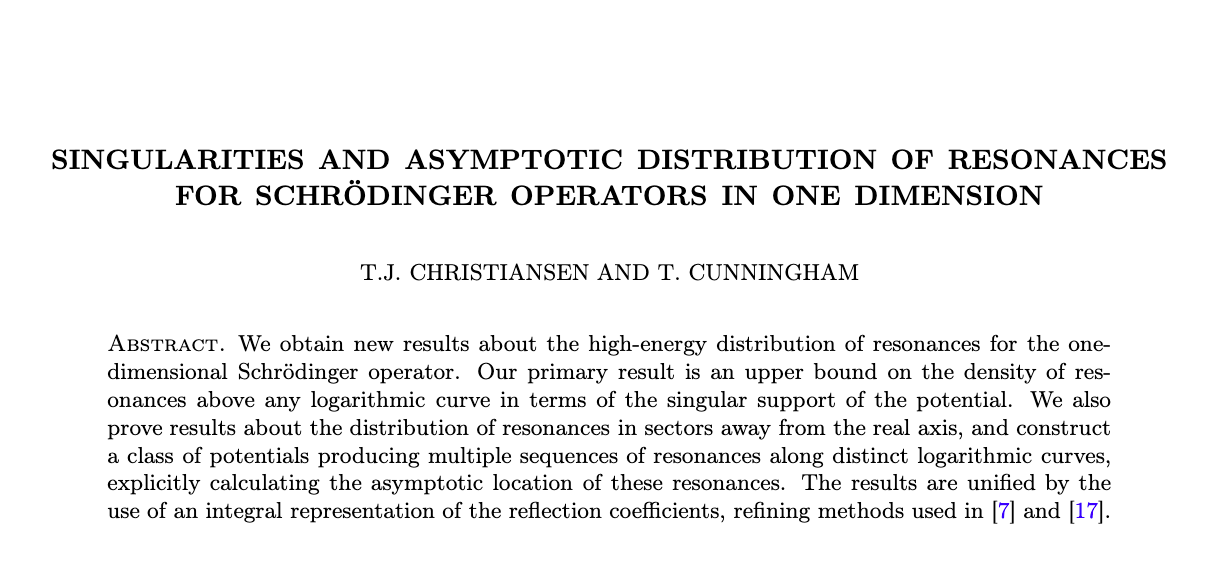
That feeling was all the more amplified when I began receiving guidance from Professor Christiansen. Unlike me, she was already an integral part of that lineage I'd hoped to continue. I hadn't thought it possible, but I doubled my intensity, working feverishly on the ideas we discussed in our correspondence. Each iteration refined the ideas, built on them, and added new results. I was caught up in the work, but I sensed an approach like a hum in the distance growing louder and louder: that goal I had dreamt of in my cell years earlier, before I had any understanding of mathematics. I'd dismissed that dream as crazy initially. But I had wanted it so badly, and it had felt so right, that I gave myself over to it completely and never looked back. I meditated on it daily. I kept myself to a strict routine. I spent years paying my dues studying textbooks, then researching monographs and papers, until finally reaching out to the experts. Now, looking at all that Professor Christiansen and I had created, I realized we had the results of a solid research paper. Indeed, our paper was published in 2025, and it still felt as crazy as it did when I first imagined it all those years ago.
In this post, I'd like to talk about the contents of that paper. It is impossible to talk about my research in a way that will simultaneously maximize understanding for the layperson, the mathematician with different expertise, and the fellow researcher in the theory of scattering resonances. But I will try, and I hope there is something for everyone.
I should start with the question: What are resonances? Physically, resonances represent certain characteristic data for the system at hand. Suppose we are given a physical system in which energy can escape to infinity. For example, one might think of an infinite pond, where any initial stimulus (such as dropping a pebble) causes some waves that ripple outward indefinitely. Another example is given by gravitational waves rippling outward after a black hole merger, as I mentioned above. In each of these systems, we have waves that both oscillate and decay with time. Resonances describe this pattern of oscillation and decay with precision.
These patterns are captured mathematically by complex numbers, and indeed, resonances most often form a discrete set of points in the complex plane. Here, the layperson might picture an infinite grid, like a sheet of graphing paper extending to infinity in all directions. Resonances are just points distributed on this grid. Given a resonance (represented by a complex number), its real part quantifies the rate of oscillation, and its imaginary part quantifies the rate of decay of a particular mode of a given physical wave. These modes have a factor of exp(i × resonance × time), showing explicitly why the real/imaginary parts correspond to oscillation/decay, respectively.
Math meets physics in the field of scattering resonances in many beautiful ways, but none are as stunning as the expansion of waves in terms of resonances. We often model physical systems using partial differential equations, which relate rates of change of certain quantities in a precise way. One such equation is the wave equation, describing the evolution of physical waves over time. In many important physical systems, there are theorems showing that solutions to the wave equation on these systems may be expanded in terms of resonances. This is useful for two (related) reasons: First, if we know information about the resonances, then we can describe properties of the wave. Second, it explicitly shows the oscillation and decay properties of a wave by decomposing it (modulo a remainder term) into its "modes", which depend upon the resonances.
For all of these reasons, it is an important problem in mathematical physics to describe the properties of the resonances. This can be done in several ways, and in future posts (as my other papers are announced), I will describe several interesting approaches, including spectral gaps, results for generic parameters, and fractal Weyl bounds. But my first-ever attempts at researching were motivated by the idea of resonance stability. I wanted to determine how resonances change when certain parameters of the physical system are allowed to vary slightly, and specifically whether there are instances in which infinitely many resonances can be shown to be stable uniformly under perturbations. I was motivated by the problem of asymptotic distribution of resonances in potential scattering and used uniform stability as my approach. This is what I initially wrote to Professor Christiansen about.
She quickly pointed out a specific scenario in one-dimensional potential scattering where the exact phenomenon I mentioned seemed possible. In a famous paper, Maciej Zworski shows that there are potentials that produce an explicit sequence of resonances asymptotic to a logarithmic curve. These potentials have certain singular behavior at the endpoints of the support, and Zworski's proof shows how those singularities actually produce the resonances. Thus, what happens if we perturb such a potential by a smooth one (e.g., one with no singularities)? It turns out that the (infinite) sequence of resonances is indeed uniformly stable under such a perturbation! This is one of the main results of our paper, and the methods we developed to prove it led to several other interesting results.
Describing the methods we developed would quickly become far more technical than I intend for this expository account of our paper. Suffice it to say that our methods led to new information about how the singular behavior of a potential translates to properties of the scattering determinant. The scattering determinant, in turn, is massively important to the study of resonances since it is a meromorphic function, and resonances can be characterized in terms of its zeros (allowing us to apply methods of complex analysis to study resonances). Thus, our methods gave us a new way to describe the connection between the singular behavior of the system and the distribution of the resonances in a precise mathematical manner. For this reason, a second theme emerges in our paper.
Pulling on that thread, we noticed that we could give a bound on the scattering determinant in logarithmic neighborhoods of the real axis in terms of the singular support of the potential. Combining this with a Jensen-type formula for an ellipse, we proved that the number of resonances in logarithmic regions is bounded in terms of the singular support of the potential. This result is related to a famous result in the theory of scattering resonances, which states that a smooth potential has at most finitely many resonances in any logarithmic neighborhood of the real axis. Our bound gives a measure of how many resonances can occur in such regions when the potential is not smooth.
By modifying the example from Zworski mentioned above, we illustrate that potentials may produce resonances in logarithmic regions that exhibit more complicated structure than a single string of resonances along a logarithmic curve. In fact, we use our new methods to provide examples that produce multiple such strings. This phenomenon is closely related to a concept called "diffraction of singularities" and provides a simple, one-dimensional arena in which to explore this concept. It also gives a new class of physical systems for which resonances can be determined explicitly. Such systems are very rare across all settings in the theory of resonances.
A final result returns to our original theme on resonance stability. By comparing scattering determinants for a potential and its perturbation and applying some complex analysis, we provide a stability result that describes how much the resonances can change when we perturb the potential in a specific way. It applies to all resonances in a given sector, hence infinitely many of them, in some circumstances.
It is an intriguing question whether our results apply to higher dimensions and to other physical settings. In a forthcoming paper, we investigate such questions and have found some partial answers. I'm excited to share some of those improved results in a later post.
There are aspects of our paper that are right on the front lines of some budding topics in the field of scattering resonances. Our paper, like each advancement in math and physics, built on the ideas of past papers and nudges our collective understanding forward. I like to picture myself as part of an army of researchers together placing their hands on the boundaries of human knowledge and pushing with all their might, just as our ancestors have done from the first moments we began peering out into our world and beyond, asking what it all means. But for me personally, the paper represents something more.
I’m proud that I trusted the intuition of meditation. I’m proud of the determination and discipline it took to take control of my life and achieve that vision. Far too often, we feel helpless, letting go and letting life happen to us. We float along in life feeling like victims of circumstance, of our environments, of our past choices. Certainly, some aspects of life are out of our control, but the degree to which our choices and perspectives impact our lives is dramatically underestimated. My life is a perfect example of that fact. The first half of my life was spent letting life happen to me, and what did it yield? Destruction, chaos, tragedy. All things diametrically opposed to who I am inside and what I believe in. My journey, from an awakening meditation telling me to take control to the reality of a publication in mathematical physics, is a reminder of the power of choice. The only way to get what you want out of life is to take control, through consistent, genuine repetition of the same work and the same constructive choices. You really can achieve that impossible goal.