The Prison to PhD Pipeline: Navigating the Storm
Travis Cunningham is a researcher in mathematical physics, in the subfield of scattering resonances.

I felt like I was on top of the world. I had just discovered the final lemma needed to prove a major theorem providing a new bound on the number of resonances on hyperbolic surfaces. But the sound of steel doors opening at the end of the hall dragged me back to reality, back to my prison cell where I sat with my legs crossed on my bunk, papers and books sprawled about. I would find out later that there had been an emergency here at my facility, and an urgent search had begun with officers going cell to cell. We were all cuffed and piled into a room while our cells were searched for over an hour. It had nothing to do with 99% of us, but we all take the brunt when something happens here. Property was confiscated or thrown away, and our rooms were trashed. When I returned to my cell, I found several of my books destroyed or missing. But far worse, the hundreds of pages of my notes and countless papers sent to me were gone... including everything I had just discovered to prove my theorem. Of course, I remembered how I came to the result and would be able to rewrite the proofs in time, but this was a serious (and unnecessary) setback, unique to researching in my situation. I took it personally that they had attacked my mathematics, of all things.
But I was productive. Math has always been my way to rebel against this environment, and I channeled that anger into my research. Within three days of having my project destroyed, I had reproved the theorem, added a new resolvent bound, translated the method to the setting of quantum baker's maps, and had written a draft of a paper. It was as if something had been awakened in me. By attacking my project, they were unwittingly throwing fuel on the source that drives me. And I vented it into the creation of my first solo paper.

My first draft went through several revisions, of course. But this draft, written in the haze of anger and resolution, became my first solo paper. "Improved fractal Weyl bounds matching improved spectral gaps for hyperbolic surfaces and open quantum maps" was recently posted to ArXiv and submitted for publication. Although the final results appeared like lightning striking that weekend, they all had their roots in the years-long correspondence with the person who helped me navigate through the storm. I've had the phenomenal privilege of having not one, but two mentors guide me on the path to becoming the mathematician and person I am today.
I began corresponding with Dr. Semyon Dyatlov in the summer of 2021. I mentioned in a previous post that it was his monograph, written with Dr. Maceij Zworski, The Mathematical Theory of Scattering Resonances, that introduced me to the field of scattering resonances. I would not have found a love for the theory of resonances had it not been for the care and intention with which they present our field. It seemed to call tome, every turn of the page revealing some striking new result connecting the math and the physics, inviting further investigation. Their own passion for our field bled through those pages and infected me in the best way.
But Professor Dyatlov's contribution to our field extends well beyond this monograph; he has pioneered new techniques that are so powerful they not only prove new results in our field, but they are also spilling over into other areas of research. In particular, his fractal uncertainty principle, a new technique in harmonic analysis, has opened the door to some deep new results, such as lower bounds on the mass of eigenfunctions, improved spectral gaps, and fractal Weyl bounds, to name a few. His work is on the cutting edge of our field, and I have recognized him as a leader since my earliest days studying resonances. I'm extremely fortunate to have received his guidance and advice over the years, about both math and my plans for the future, including grad school.
My initial research attempts dealt with the distribution of resonances in potential scattering on Euclidean spaces, which occupies the first couple of chapters of the monograph by Dyatlov and Zworski. Although the open problems in this setting are by no means simpler than in other settings, the primary methods used in their investigation generally are. With a strong understanding of complex analysis and Fredholm determinants, one can penetrate rather deeply into the theory in this setting, so that is where my passion for this field, as well as my early attempts at research, began.
Simultaneously with my initial research projects, I continued to explore deeper and broader into the field. I became highly interested in the connections with the dynamics of the system, and there are a number of fascinating results connecting the set of classically trapped trajectories with the distribution of quantum resonances. The description and analysis of the trapped set for a given system is thus the key to describing the resonances, but as of now, our understanding is still a work in progress.
These ideas are where much of my correspondence with Professor Dyatlov has its roots, and in how they pertain to spectral gaps and fractal Weyl bounds. Recognizing the power in the fractal uncertainty principle and wanting to learn more, I began discussing its applications to resonance distribution with him. He graciously offered me his time and advice, dropping bits of insight and guiding my investigations. He has a masterful way of describing extremely complicated concepts in a digestible way, and I have benefited from this on numerous occasions. There have been times when I have read several papers on a topic without gaining much in understanding. A single email to and from Professor Dyatlov clarifies things almost instantly. His skill in condensing tons of complicated information into its essential points is something I've tried to emulate, and it has significantly enhanced my research.
Through this pattern of reading research and discussing concepts together, I eventually began to feel I could contribute to these areas. By sending me current research, pointing to open problems and conjectures, and even suggesting approaches to their solution, Professor Dyatlov was essential in guiding me to the perfect problem to pursue: an improved fractal Weyl bound matching an improved spectral gap. My second paper, mentioned above, provides a solution.
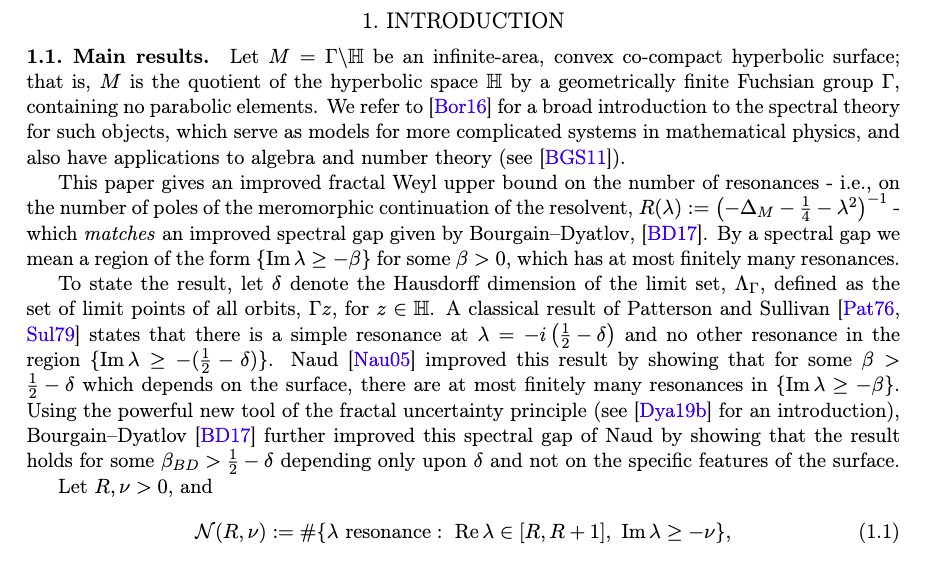
My paper combines two important applications of the fractal uncertainty principle to obtain a new upper bound on the number of resonances on hyperbolic surfaces. Recall that the fractal uncertainty principle is a tool in harmonic analysis that states that a function cannot be simultaneously localized in both position and frequency near a fractal set. It turns out that for many important scattering systems, the set of trapped trajectories has a fractal structure. Moreover, resonant states—which are associated with resonances similarly to how eigenvectors are associated with eigenvalues—are microlocalized near the set of trapped trajectories. This allows an application of the fractal uncertainty principle to prove that resonances must lie below a certain threshold line in the complex plane. We call this a spectral gap, and it has important implications for the wave decay of the system. The fractal uncertainty principle, developed by Professor Dyatlov and his collaborators, allows for the best spectral gaps currently known, improving over prior results.
Another application of the fractal uncertainty principle is to provide an improvement to what's called a fractal Weyl bound. Many of you are familiar with Weyl's law for the asymptotics of eigenvalues on closed systems. When the system is open and energy may escape to infinity, eigenvalues are replaced by resonances whose distribution is far more complicated. But we can obtain an upper bound on the asymptotic number of resonances analogous to the Weyl law. The bound is given in terms of the fractal dimension of the trapped set, so we call this a fractal Weyl bound. It has been known in a variety of settings for some time, but more recently, using the fractal uncertainty principle, Professor Dyatlov was able to improve the bound so that it interpolates linearly to match a spectral gap. More precisely, his upper bound vanishes in regions where it is known that there are no resonances, giving improved estimates on resonance density in a region below this spectral gap.
These two results are combined in my paper to improve the latter result even further, giving a bound that vanishes at an improved spectral gap determined by the fractal uncertainty principle. This improves known estimates for the number of resonances on hyperbolic surfaces in certain physically relevant regions. As a byproduct of the approach, an improved bound is also given on the resolvent. Interestingly, the resolvent bound is an even stronger improvement over known results since the improvement occurs in a larger region. Finally, we translate the methods to the interesting discrete setting of open quantum baker's maps, which are simplified models for more complicated quantum chaotic systems. Here, given the discrete nature of the system, an even sharper upper bound is given. We match the Weyl bound with a spectral gap directly analogous to what was done for hyperbolic surfaces, but also provide a bound matching a spectral gap given by an additive energy estimate. The latter is obtained via certain combinatoric methods. It is really delightful when so many different areas of math combine to give new results. Together, my results give the best-known bounds for the density of resonances and the best resolvent bound for hyperbolic surfaces.
Yet, as was the case for my first paper, this paper represents more than the mathematics on its pages. I couldn't have done it without Professor Dyatlov's suggestions and discussions, but despite the generous help I received, this is my first solo paper, and I'm very proud of that. I had to work through every single detail and write and organize every line in the paper. I also had to overcome significant hurdles, including starting from scratch when my work notes were destroyed in the cell search.
Sometimes, my internal struggles paired with the daily drudgery of prison are so frustrating and so relentless that I don't know what I would do without mathematics. I'm passionate about math and my field for their own sake. That passion is self-sufficient and sustained no matter what's going on around me. But the reason I put so much pressure on myself to succeed and to contribute to mathematics is in part to separate myself from the tempest inside and around me. It's like therapy: nothing calms the storm quite like mathematical discovery. It reminds me that the world is not total chaos, despite seeming that way sometimes. There exists beauty and order, and my mind is not only capable of seeing and understanding that beauty and order, but also contributing to it and striving for it. My mentors, Professor Christiansen and Professor Dyatlov, have ensured that I don't have to do it alone. What they're doing is about so much more than mathematics. They've steadied me like anchors during this storm, and I'm forever grateful.